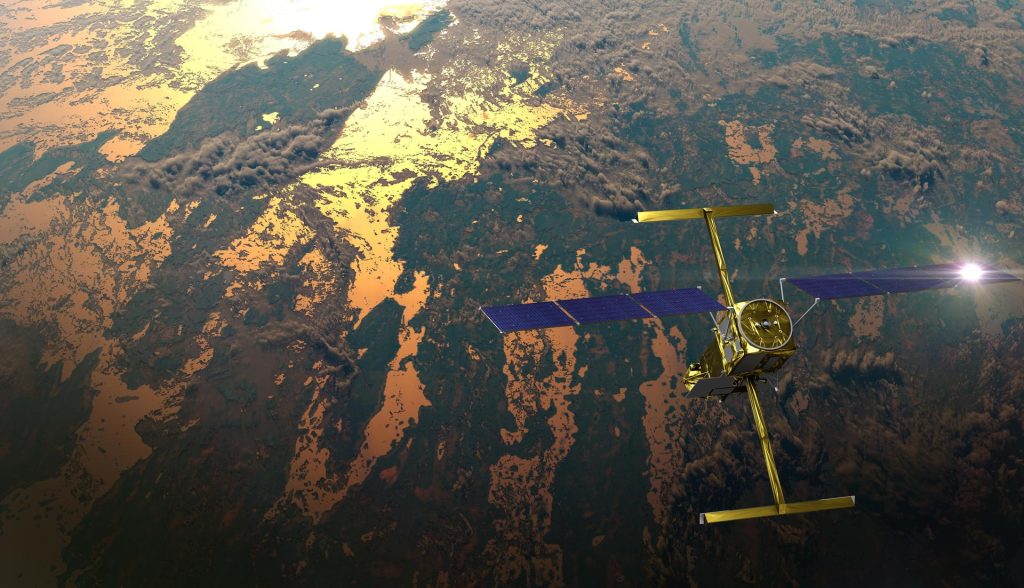
Image: illustration of a satellite in orbit, via NASA · Public Domain
GPS is so routine that it is easy to forget it relies on extremely faint signals. A report from MIT Technology Review explains how growing interference is accelerating the search for technologies that complement satellite navigation.
Strong on paper, fragile in practice
Positioning satellites orbit thousands of kilometers up, so their signals reach the ground with very little power. That makes them vulnerable to jamming (blocking) and spoofing (faking) using relatively simple equipment. The article notes that thousands of flights have been affected by interference since 2022, and that in September 2025 a Spanish military aircraft had its GPS jammed in mid-flight.
Modernization from above
The constellation itself is evolving. GPS III satellites add new civilian signals (L1C and L5), expected to be fully operational later this decade. A military M-code is rolling out, and the first GPS IIIF satellites, scheduled for 2027, will add a more powerful regional beam. Low-Earth-orbit navigation constellations are also being explored, since their signals arrive stronger and allow faster position fixes.
Quantum sensors as a backup
The other path is to avoid depending on satellites alone. Companies such as Infleqtion and Q-CTRL are developing cold-atom inertial sensors and navigation based on Earth’s magnetic field. Q-CTRL claims, in a study not yet peer reviewed, that its system tracked a light aircraft up to 94 times more accurately than a conventional inertial system. One expert quoted sums up the trend: always think in terms of sensor fusion.
What a fleet operation can take from this
The practical lesson is that no single positioning source should work alone. Combining GPS with other vehicle data, checking route consistency and reviewing signal-loss alerts lowers the risk of acting on a wrong position. Understanding how satellite technology works helps you demand more from the tools behind your operation.
If you want to see how a tracking platform can support control of your fleet, learn more at www.esencialgps.cl.
Based on data from MIT Technology Review.