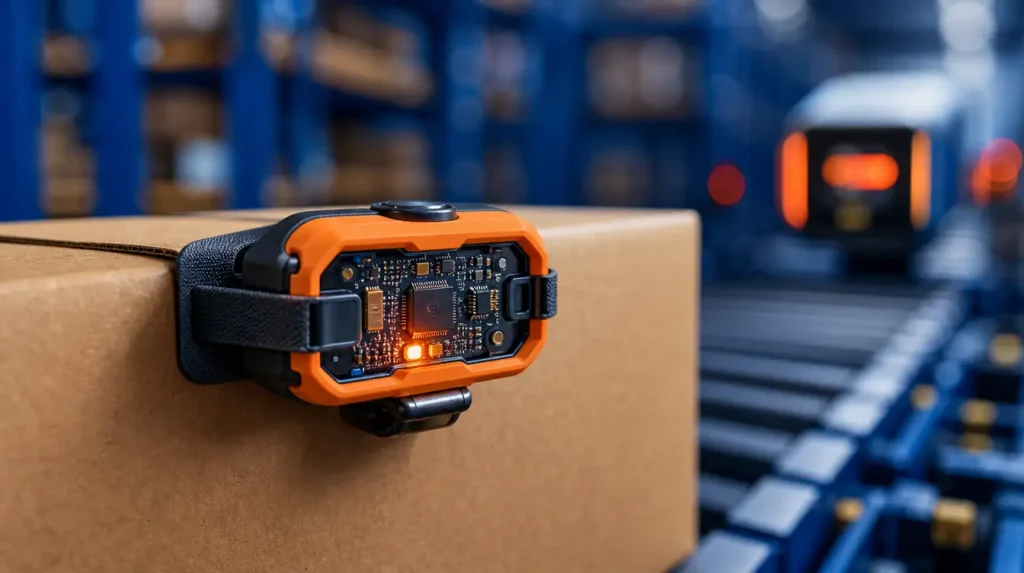
When John Deere replaced 100 Wi-Fi access points with just 14 cellular microcells at one of its plants, it did more than simplify its infrastructure: the cellular network cost roughly 75% of the wired setup it replaced. It is one of many signs that private 5G networks are moving from pilot projects into real industrial operations, with direct consequences for anyone managing fleets and assets across large facilities.
What a private 5G network is, and why it matters beyond the factory
A private 5G network is a cellular network dedicated to a single site or operator, running on spectrum licensed for that purpose. Its low-power variant, known as RedCap (Reduced Capability) and standardized by 3GPP in 2022, connects large numbers of long-battery-life devices without overloading the network. At Mobile World Congress 2025, Hyundai and Samsung showcased a RedCap-based private 5G network at the Ulsan plant, a five-million-square-meter site that builds 6,000 vehicles a day. According to Hyundai, the advantage is not only speed but reliability when coordinating thousands of wireless devices without the interference Wi-Fi struggles with on a factory floor.
Why large logistics operations are adopting them
Ports, mines, distribution centers and logistics yards share one problem: many vehicles, guided equipment and sensors moving across vast areas where Wi-Fi leaves dead zones. A private network answers with:
- Reliable coverage over large footprints, with no dropouts or blind spots.
- Low latency for guided vehicles, mobile robots and safety alerts.
- Control and security, since the operation runs its own network.
- Scalability for thousands of sensors: John Deere plans to grow its sensor count by around 200%.
Analyst firm Analysys Mason estimates private networks will grow at roughly a 65% compound annual rate through 2027, a pace that confirms they are no longer an experiment.
What it means for fleet management
For a fleet operating inside a port, a mine or a large distribution center, reliable connectivity is the foundation for everything else. Without it, location, telemetry and safety data arrive with gaps, and alerts lose their value. A stable network turns real-time tracking into something genuinely continuous. Not every operation needs to build its own 5G network, but the trend clearly shows where industrial connectivity is heading: dedicated, low-latency and designed for thousands of devices.
The EsencialGPS platform centralizes your fleet’s location and data in real time, so as connectivity improves —through private 5G or today’s networks— your operation makes the most of every data point without losing continuity. Learn more at www.esencialgps.cl.
Based on data from IEEE Spectrum.