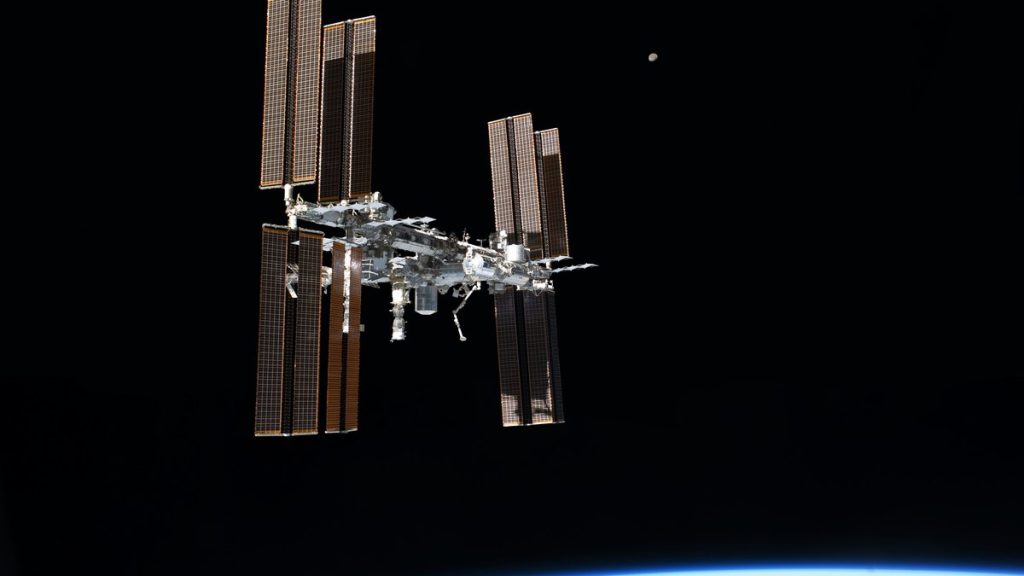
Photo: NASA via Wikimedia Commons · Public domain
The International Space Station will stop operating in 2031, and its replacement will not be publicly owned. NASA has committed more than 500 million dollars to companies building private orbital outposts, and firms such as Vast, Axiom Space, Voyager and Blue Origin plan to place their own stations in orbit between 2027 and 2030. Low Earth orbit is becoming commercial territory, with implications that reach well beyond tourism.
From public lab to private business
For more than two decades, the International Space Station worked as a laboratory funded by government agencies. The emerging model is different: NASA wants to be one customer among many rather than the owner of the infrastructure. Vast expects to launch Haven-1 in early 2027, a bus-sized module designed for four-person crews and stays of around ten days. Axiom Space is planning a five-module station by 2028, the same target date as Voyager’s Starlab. Blue Origin’s Orbital Reef is aiming for 2030. Each project has to prove it can operate safely and pay for itself without a permanent public budget behind it.
What a private station is for
Microgravity enables experiments that are hard to reproduce on Earth: growing plants, testing pharmaceuticals and manufacturing materials with more uniform structures. Add orbital tourism, with tickets that will initially cost tens of millions of dollars, plus the use of these platforms for Earth observation, connectivity and in-orbit satellite servicing. In practice, each station works like a small industrial park in space, with services rented by time and by payload, and with several operators competing for the same customers.
Why fleet operators should watch low Earth orbit
Commercialising low Earth orbit speeds up the entire chain that ground operations already rely on: more launches, lower access costs and more satellites dedicated to positioning, observation and communications. For anyone running a fleet, the point is not to board a rocket, but to understand that the space layer behind GPS positioning and backup satellite connectivity is becoming denser, more competitive and more resilient to failure. Satellites are enablers of that operation, not a replacement for the tracking that already works on the ground.
At EsencialGPS we keep a close eye on how the space and connectivity infrastructure behind fleet management evolves, so that every improvement in orbit turns into more reliable data on the road. To discuss how these advances apply to your daily operation, learn more at www.esencialgps.cl.
Based on data from MIT Technology Review.